🐴 What the Donkey Sees: Building AI Buz
by Yakira Spielman (MefarshAI Intern)


When we started this project, we were returning from lunch, sitting in my Uncle Dave’s car. We opened up ChatGPT to brainstorm some ideas for how to make the Parsha interactive and meaningful.
We didn’t have a plan — just curiosity and a lot of laughter. Also, lunch was yummy :)
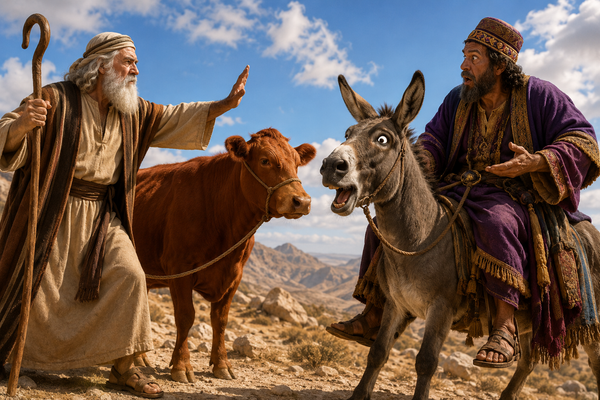
Eventually, we landed on the idea of a talking donkey — inspired by Bil’am’s donkey from this week’s Parshat Balak. You know the one: stubborn, soulful, and the only creature wise enough to stop in his tracks because he saw what Bil’am didn’t — an angel standing right in front of them.
That moment became our spark.
🎙 Meet Buz

Buz.nivra.org features a crayon-drawn (we tried), animated donkey named Buz. He talks. He listens. He asks simple, real questions like:
“What made you smile today?”
“Tell me about a challenging moment this week.”
And then — like the original donkey — he offers advice in the form of gentle mussar. The kind that makes you stop and notice what might already be right in front of you.
It’s not a lecture. It’s not even a teacher. It’s just… Buz.
🚧 What Was Hard
One of our first challenges was animation. We wanted Buz to be expressive — not just a static cartoon. We tried a lot of things: drawing the donkey, animating it in Canva, searching NounProject, even asking AI to help us generate art. Eventually, we found a Lottie animation of a talking donkey that worked, and Lovable helped us wire it into the code.
The next big challenge? Giving Buz a voice.
We needed him to sound a certain way — a little stubborn, a little smart, a little old-soul. After testing voices, we settled on one from ElevenLabs called Sully that felt just right. Then came the hard part: connecting the voice to the app, making it work smoothly with OpenAI’s chat engine, and making sure it auto-started when someone clicked “Get Bil’am’s Donkey Moving!”
There were a lot (a lot) of technical bumps, but eventually, it all came together. Then we finally got to hang out with Buz.
🧠 What I Learned
I had never built anything like this before. I’d never used AI tools, never worked with code, and never been part of a creative tech project. But by the end, I got to lead the vision, make design decisions, and help shape something that didn’t exist before.
It’s pretty wild to go from “random idea in a car” to a working website where other teens can actually have a meaningful interaction with the Parsha.
🕊️ Why It Matters
This week’s Parsha reminds us that sometimes the truth is right in front of us — but we need help seeing it. That’s what the donkey did for Bil’am.
And maybe that’s what Buz can do for you.
So go ahead — click the button. Talk to a donkey. You might be surprised what you learn.
✍️ Written by Yakira Spielman, 10th Grade
📝 Postscript from Uncle Dave
Seriously — could I be any prouder? Way to go, Yakira.
I feel so lucky to live among family — and not just family, but family that truly loves and likes each other. This year, I set out on a new mission: to really get to know and spend meaningful time with all my nieces and nephews (on both sides of the ocean). After a gentle nudge from one niece and some wisdom from a sibling, things finally got rolling.
Our uncle-niece lunch last week was fun, delicious, and left us both with a lot to think about. I hope I managed to pass on some of my lead-with-curiosity spirit… and not too much of my ADHD-all-over-the-place energy 😉
Side note:
MefarshAI started as a labor of love, but it also became the very first building block of something much bigger: Nivra.

Nivra is a new nonprofit, now officially under fiscal sponsorship, with a mission to make bleeding-edge technology — such as AI — more accessible to the Jewish world. We achieve this through hands-on education, experimentation, and product development, as well as public-facing thought leadership.
It takes real resources to make something like this work — even for a talking donkey.
Buz alone costs about 15 cents per conversation to run. That might not sound like much, but when you’re building cutting-edge tools for learning and growth, those micro-costs add up fast. At scale, we’re looking at roughly $150 per month per 1,000 conversations. And those are just the API calls.
The real cost?
It’s the hours of experimentation, the prompt engineering, the Torah-grounded voice design. It’s the work of integrating sources like Sefaria, writing code, rewriting code, building systems where AI passes knowledge between other AIs, and guiding it all with care so Buz sounds wise, not just clever.
We believe every minute and every dollar is worth it — because every experiment leads to a more meaningful encounter with Torah, with technology, and with ourselves.
If you’ve smiled talking to Buz, learned something from MefarshAI, or believe the Jewish community deserves to lead in conversations around ethics, AI, and wisdom —
We’re just getting started.
-Dave