The Machine That Never Sleeps


What Tikkun Leil Shavuos teaches us about learning that AI cannot replicate
Mefarshai · May 2026
Tonight, Jews around the world will stay up all night learning Torah. No particular tractate is mandated. No single text is prescribed. Just a person, a candle (or fluorescent classroom light), a chavrusa, and the open expanse of sacred text — until dawn.
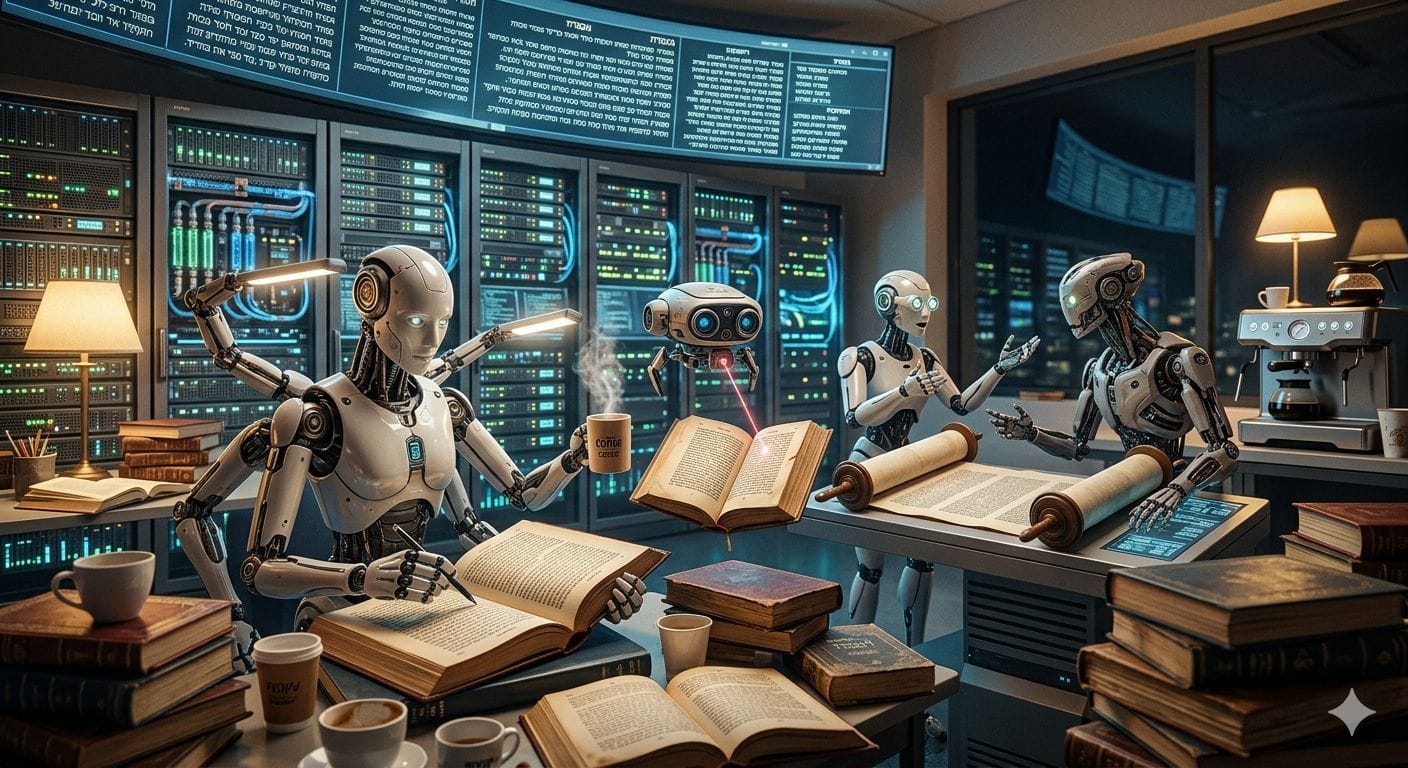
Meanwhile, somewhere on a server farm, a large language model is also "awake." It has been awake every night this week, and last year, and for every hour since it was deployed. It has processed more text than any human could read in a thousand lifetimes. It never tires. It never loses focus at 3 a.m. It never needs another cup of coffee.
So here is the obvious question that Shavuos forces us to sit with: if AI never sleeps, never forgets, and can retrieve any Torah source in milliseconds — what exactly are we doing up all night?
🕯️ What the Rav Said About Learning
Rabbi Joseph B. Soloveitchik drew a radical distinction between two modes of engagement with Torah. The first is Torah as information: the accumulation of facts, sources, and rulings. The second is Torah as encounter — what he called a meeting with the Divine Will, a confrontation with the commanding presence of God in history.1
In Halakhic Man, the Rav describes the ideal Torah scholar not as a passive receiver of transmitted data, but as a creative intellect who "recreates" the legal cosmos through his learning. The point of Torah study, in his framework, is not merely to know what is written — it is to be transformed by the act of engaging with what is written.
"The study of Torah is not simply an intellectual exercise but an act of devotion, a form of worship, in which a person brings his entire personality to bear upon the text."
— Rabbi Joseph B. Soloveitchik, Lonely Man of Faith
No AI model is transformed by reading Torah. It is shaped by its training data, yes — but that shaping is statistical, not covenantal. It has no relationship with the text. It has no skin in the game. It cannot stand at Sinai.
📜 The Night Itself Is the Point
The Magen Avraham, in his classic commentary on the Shulchan Aruch (Orach Chaim 494), records the basis for Tikkun Leil Shavuos in a striking critique: the generation that received the Torah at Sinai overslept that morning.2 God had to rouse them! Our all-night learning is, in a sense, a tikkun — a repair — of that original failure of readiness.
But look at what that framing implies. The goal of the night is not efficiency. We are not trying to cover more ground than we covered last year. We are not optimizing output. We are demonstrating readiness. We are saying: we will not be caught sleeping when the moment comes. We will be present.
Presence, by definition, is not something that can be outsourced.
Rabbi Nachman of Breslov — whose approach to Torah could not be more different from the Rav's, yet who arrives at an eerily similar place — teaches that every person has a unique "chelek" in Torah, a portion that only they can illuminate.3 The implication is staggering: there are dimensions of Torah that will remain forever dark unless you, specifically, engage with them. No model, however vast, carries your unique nefesh into the text.
🤖 What AI Does Brilliantly
— and What It Cannot Do
Let's be honest about what AI offers the learner: it is genuinely extraordinary. A student today can ask a question about a machloket Rishonim and receive a nuanced, sourced summary in seconds. An educator can prepare a shiur in a fraction of the time it once took. A baal teshuva with no yeshiva background can access the depth of the tradition in ways that were unimaginable a generation ago. This is not nothing. This is, arguably, a democratization of Torah access with few historical parallels.
But here is what the all-nighter of Shavuos knows that the algorithm does not: the struggle is the point.
The Talmud (Berakhot 63b) famously teaches: "Torah is only acquired through one who kills himself over it."4 The medieval commentators wrestle extensively with this hyperbole, but the core point is not about self-destruction — it is about the irreplaceable role of investment. The learning that changes you is the learning that costs you something. The source you finally understand at 4 a.m., after misreading it three times, lives in you differently than the source you received as a clean summary at 4 p.m.
The Rav, in U'Vikkashtem Misham, writes that the encounter with Torah requires what he calls "recoil" — a moment of being overwhelmed, of standing before something that exceeds your capacity — before the genuine meeting can occur.5 AI eliminates recoil. It is frictionless by design. And in eliminating the friction, it may inadvertently eliminate the encounter.
⚡ Sinai Was Not a Data Transfer
The Midrash in Shemot Rabbah describes Matan Torah in terms that are almost impossible to render in a modern register. Every single Jewish soul — those present and all those yet to be born — stood at the foot of the mountain.6 The text was not delivered to a scribe for later distribution. The encounter was simultaneous, total, and — crucially — personal.
This is not the architecture of a data transfer. God did not upload the Torah to the cloud and give Moshe the login credentials. The entire design of Matan Torah was relational: a people, trembling, at the base of a mountain that shook, in the presence of something that exceeded all categories.
What we are doing on Tikkun Leil Shavuos is re-entering that posture. Not recreating the content — the content is available in a thousand printed editions and now on every smartphone — but re-inhabiting the stance. The stance of the one who shows up, who stays up, who says: I want to be present for this, not just informed of it.
The Question AI Cannot Ask
There is a feature of Tikkun Leil Shavuos that never shows up in discussions of its halachic status or its kabbalistic origins: the conversation that happens between 2 and 4 in the morning, when the coffee has worn off and the defenses are down. The question someone has been carrying for years that finally comes out. The moment a text says something to a learner that it has never said before, because the learner is finally tired enough to stop performing understanding and start experiencing it.
AI can answer questions. It cannot be broken open by them.
Shavuos is the holiday that insists: Torah was not given to angels — to perfect, tireless, infinitely knowledgeable beings. The Talmud records that the angels themselves argued that the Torah should stay in heaven, where it belonged, among those capable of keeping it perfectly.7 God overruled them. The Torah was given to us — exhausted, distracted, imperfect, sometimes-sleeping us — because its deepest purpose is not to be stored. It is to be lived.
Tonight, when you sit down to learn — whether for an hour or until dawn — you are not competing with a machine. You are doing something the machine structurally cannot do. You are showing up, in your body, with your history and your questions and your 3 a.m. fragility, and saying: I am here. I am ready. Give me the Torah.
Chag Shavuos Sameach
-Fred
Fred Goldman is Managing Partner at Gently Ventures, (including bavl.pro + Jerrypress.com), father to eight awesome kids, and a serious Sefarim geek.
Footnotes
1 Rabbi Joseph B. Soloveitchik, Halakhic Man (Philadelphia: Jewish Publication Society, 1983), pp. 19–37.
2 Magen Avraham on Shulchan Aruch, Orach Chaim 494:1, citing the Arizal's practice and its basis in Midrashic sources.
3 Rabbi Nachman of Breslov, Likutey Moharan I:34. The concept of each soul's unique "chelek b'Torah" is developed throughout his teachings.
4 Babylonian Talmud, Berakhot 63b: "אין התורה מתקיימת אלא במי שממית עצמו עליה".
5 Rabbi Joseph B. Soloveitchik, U'Vikkashtem Misham (And From There You Shall Seek), trans. Naomi Goldblum (Jersey City: Ktav, 2008), pp. 1–20.
6 Shemot Rabbah 28:6 and parallel sources on "nishmat kol dor" — the souls of all generations present at Sinai.
7 Babylonian Talmud, Shabbat 88b–89a: the debate between Moshe and the angels over the giving of the Torah.