Noach: The First Patent
When Torah Meets Toolbox

Every generation faces the same question in different garb:
Are our inventions tools for tikkun — repair — or instruments of tohu — chaos?
Parashat Noach doesn’t usually make the innovation headlines. We picture the ark, the flood, maybe the rainbow — not the workshop. But tucked between genealogies and rainfall charts lies a quiet revolution: the birth of the tool.
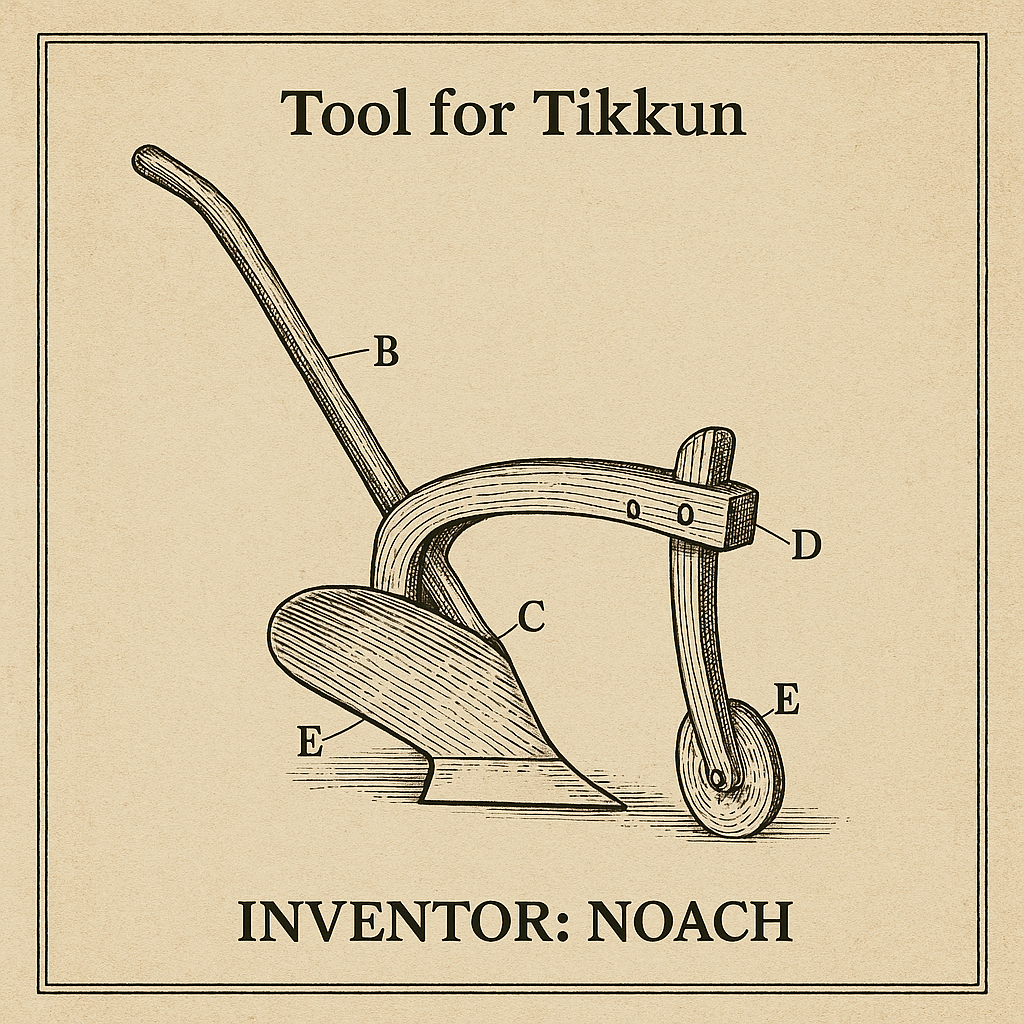
Before the ark, there was the plow.
Before salvation, there was invention.
Rashi and the Midrash tell us that Noach didn’t just build a vessel — he built the first kli, the first extension of human hands meant to ease toil. If Adam introduced labor, Noach introduced leverage.
In a week when we’re all talking about “AI tools,” it’s worth remembering: humanity’s covenant with tools begins here.
“This one will comfort us from our work and from the toil of our hands, from the ground which Hashem has cursed.”
— Bereishit 5:29
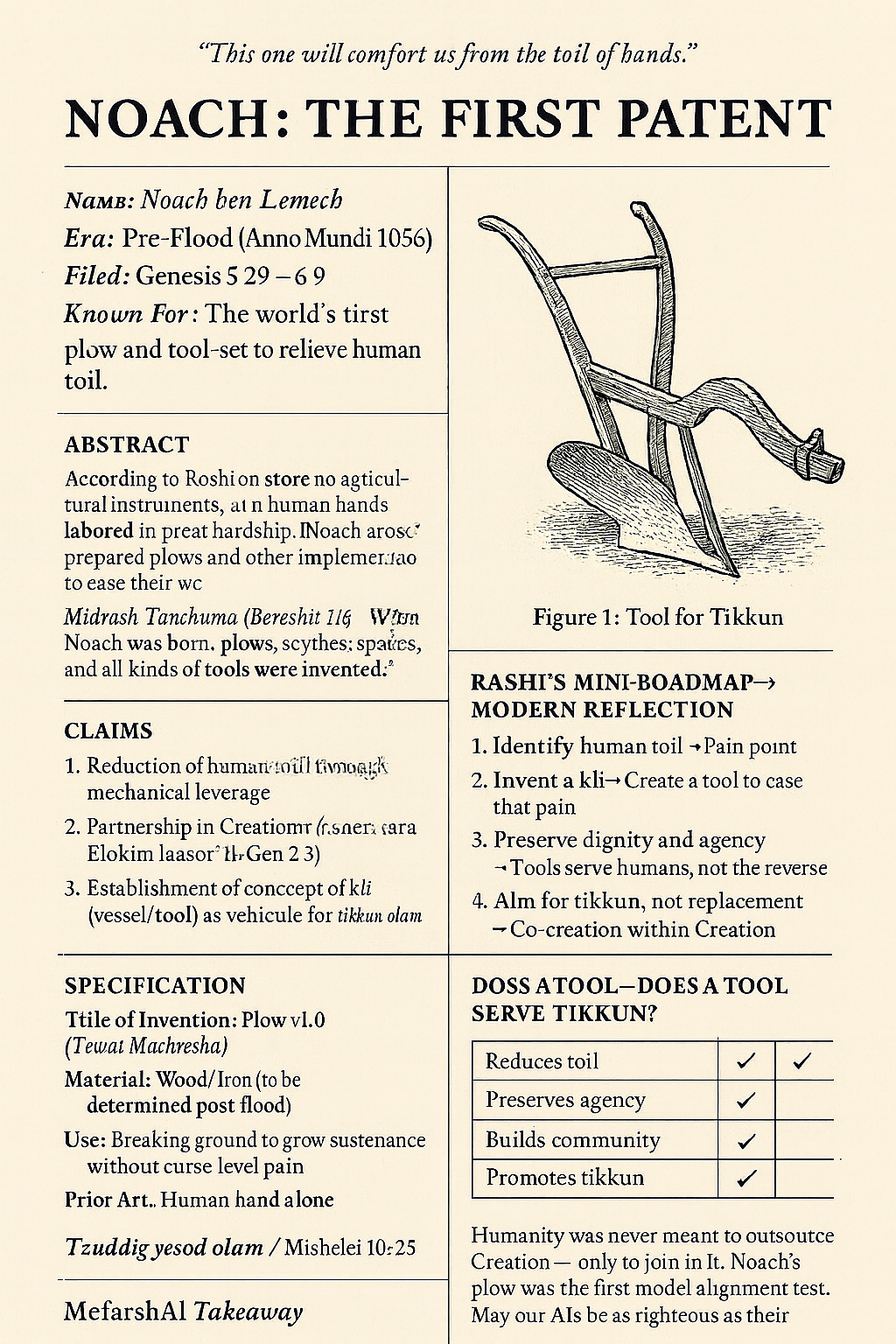
Patent Application
ID: 0000000001 SUBMITTED ON: Bereishit 5:29 – 6:9. Pre-flood STATUS: Approved
🧑🔬 Inventor
Name: Noach ben Lemech
Era: Pre-Flood
Filed: Bereishit 5:29 – 6:9
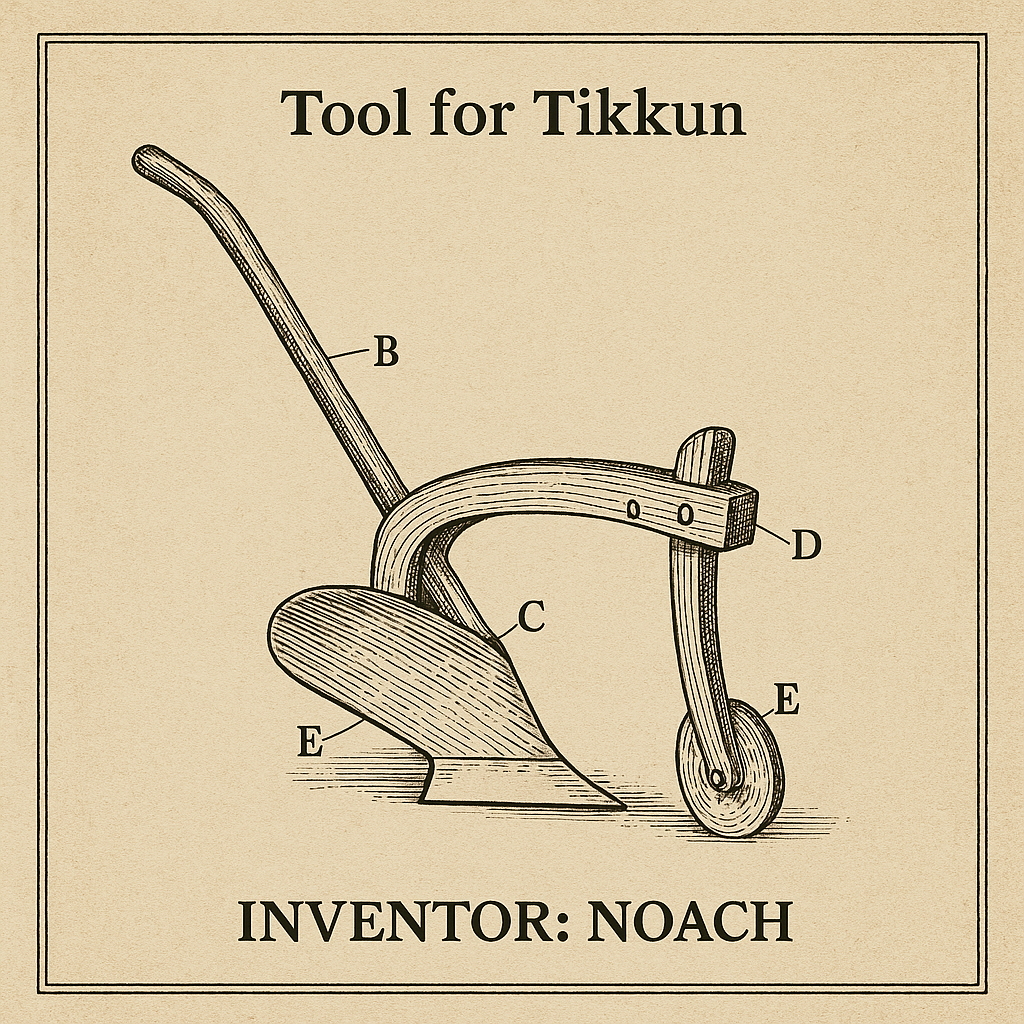
Known for: Inventing the world’s first plow and tool-set to relieve human toil.
📜 Abstract
Rashi on Bereishit 5:29 explains:
“Until Noach was born, people had no agricultural instruments, and their hands caused thorns and thistles to spring up when they tilled the ground. When Noach was born, he prepared for them plows and other implements to ease their work, and the earth yielded its produce.”
Midrash Tanchuma (Bereshit 11:6) adds:
“When Noach was born, plows, scythes, axes, and other implements were introduced into the world.”
These are the earliest textual witnesses of human invention: Noach as the prototype inventor, whose insight lessened the curse of Adam’s toil.
⚙️ Claims
1️⃣ Reduction of human toil through mechanical leverage
2️⃣ Extension of Creation through human action, fulfilling “אֲשֶׁר בָּרָא אֱלֹקים לַעֲשׂוֹת” — “which God created to make” (Bereishit 2:3)*
3️⃣ Establishment of the kli (vessel / tool) as a means for constructive and ethical work
*Interpretive note: This reading reflects classical commentators who see this verse as a mandate for human partnership in Creation.
🧭 Rashi’s Mini-Roadmap → Modern Reflection
- Identify human toil → define the pain point
- Invent a kli → create a tool to ease that pain
- Preserve dignity and agency → tools serve humans, not the reverse
- Aim for partnership, not replacement → co-creation within Creation
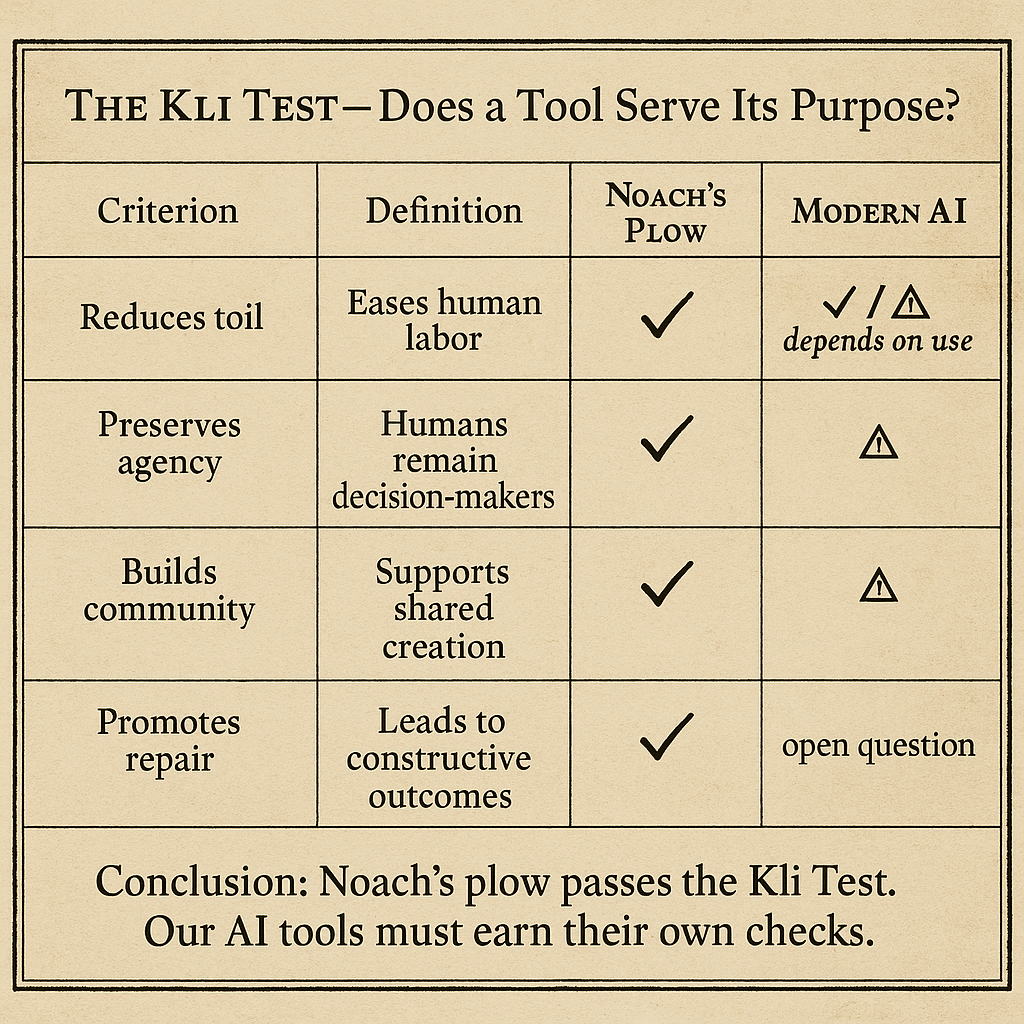
In our generation, AI is a new kli. If it reduces toil while preserving our agency, it belongs in Noach’s line of patents.
✅ The Kli Test — Does a Tool Serve Its Purpose?
🪴 Reflections — Tools, Towers, and the Work of Our Hands
When I think about Noach, I don’t picture a shipbuilder — I picture an inventor.
The Torah says, “This one will comfort us from the toil of our hands,” and Rashi explains that before Noach, no one had yet built tools to ease human labor. Noach’s genius wasn’t just survival; it was design — the creation of a kli that extended human purpose instead of replacing it.
That’s the central tension of every generation of technology:
Does this tool serve us, or do we end up serving it?
AI, at its best, is our generation’s plow — a vessel that helps us dig, plant, and grow faster, but only if we remember that it’s a kli, not a covenant. Used wisely, AI can reduce toil and expand human creativity; used carelessly, it can hollow out the very meaning of “work.”
At MefarshAI, that’s the question we keep bringing back to Torah each week: what does it mean to co-create with Hashem in an age of intelligent tools? How do we build responsibly, with reverence and precision, instead of chasing efficiency alone?
After Noach’s inventions came the Tower of Bavel, where language went from single to many —and also humanity’s first great act of technological overreach. It wasn’t their engineering that God opposed; it was their intent. They built to make a name for themselves, not to serve or uplift. Their tower wasn’t a vessel (kli); it was an idol.
Our task is to stay on the side of Noach, not Bavel. To make plows, not towers. To use AI as a tool for alignment, learning, and repair — not as a monument to human ego.
Side note: I chose the name Bavl from this Parasha since this pro-grade next-gen AI tool was built to unlock those languages. Right now, we are focused on Hebrew-to-English translation and already have published projects, with many more coming. https://bavl.proIf you’re looking for a Shabbat-table question:
When we pick up new tools — from hammers to algorithms — how do we know whether we’re building an ark or a tower?
That’s the question I’m sitting with this week.
Thanks for reading and Shabbat Shalom!
Dave
dave@bavl.pro